

EXCLUSIVE EXPERT CONTRIBUTION / DUBAI, UAE
Expert commentary from SnapFixNow FMC • Engineering-led property maintenance
An office tower can report that nearly every air-conditioning unit is operational while tenants still complain about comfort, the electricity bill rises and maintenance teams repeatedly attend the same equipment. The distinction is straightforward: operating is not the same as performing.
For commercial property owners, HVAC is a business-continuity system. Poor cooling can affect tenant experience, fit-out environments and operating cost long before a complete breakdown makes the problem obvious.
Move beyond the binary status report
A conventional maintenance dashboard may classify an asset as running or failed. An engineering-led view asks more useful questions: Is the equipment delivering the required conditions? Is the energy used to do so reasonable? Is the same defect returning? Is the system creating a secondary risk such as water leakage or poor ventilation?
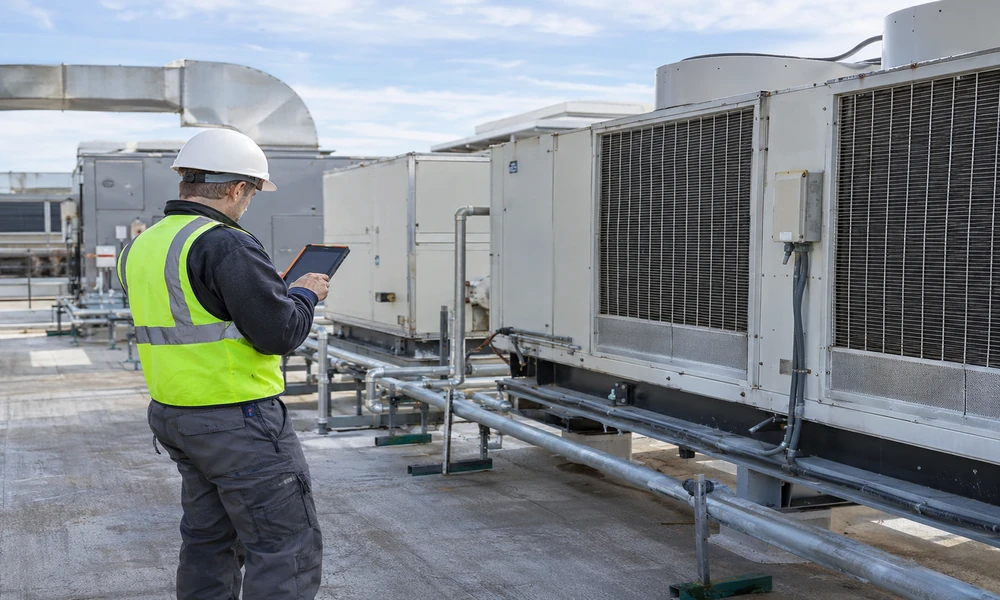
Consider an air-handling unit that runs continuously. If its filters are heavily loaded, its airflow may be constrained. If a coil is fouled or a control sensor is inaccurate, room conditions may drift. The motor can still be running when the service outcome is deteriorating.
Track five indicators that tell a better story
Comfort complaints by zone. Record the room, time, system and repeat frequency. A tenant complaint is a signal, not a technical diagnosis; patterns help focus investigation. These measures can form part of an evidence-led commercial HVAC maintenance programme with asset-level records and trend reviews.
Recurring faults by asset. Repeated resets, trips and drain blockages should trigger escalation. Counting each attendance as a successfully closed ticket can hide a persistent failure.
Planned maintenance completed with evidence. A signed checklist is useful, but photographs, condition notes and recorded measurements are more powerful when linked to the equipment ID.
Operating trend. Where available, compare energy use, run hours, setpoints and demand under broadly comparable occupancy and weather conditions. Raw utility bills alone cannot prove HVAC efficiency.
Open risks and deferred work. Separate an identified defect from an approved repair. Owners need to know whether a risk remains unresolved because of access, materials, cost approval or engineering uncertainty.
Prioritise by consequence, not only repair cost
A minor condensate leak above a high-value interior can create more disruption than a more expensive component operating in an isolated plantroom. Similarly, a small cooling fault in a hotel guestroom has a different service consequence from the same fault in an unused storage area.
An asset-criticality matrix can combine failure likelihood, safety implications, affected occupants, repair accessibility and operational disruption. This helps teams schedule preventive work where it delivers the most meaningful protection.
Know when an AMC is sufficient, and when engineering coverage is needed
An annual maintenance contract can provide scheduled inspections, breakdown response and reporting for a defined asset list. A larger property with daily tenant requests, multiple contractors and continuous system dependencies may also need facility-management coordination or on-site engineering coverage. For more demanding properties, an outsourced engineering team can provide day-to-day technical ownership beyond periodic visits.
Those are not interchangeable products. AMC describes a service contract; facility management provides wider governance; an outsourced engineering team supports or replaces the daily technical workforce. The right structure follows actual operating demand rather than a fashionable label.
Make every completed job improve the next decision
A useful service record captures the symptom, diagnostic evidence, corrective action, result and follow-up requirement. Over time, those records reveal whether faults stem from aging equipment, poor maintenance access, unsuitable controls or repeated operating conditions.
That knowledge is more valuable than simply increasing the number of visits. It supports replacement decisions, tender scopes and more credible budget forecasts.
The best commercial maintenance programmes do not ask only whether the AC is switched on. They ask whether it is doing its job reliably, efficiently and with evidence that the owner can trust.
A scorecard that exposes repeat losses
A practical facilities dashboard can track five indicators without claiming they are universal performance standards: (1) recurring complaints per occupied zone; (2) repeat faults per asset within a defined review period; (3) planned work completed with recorded evidence; (4) unresolved risk exposure, including age and business criticality; and (5) comparable energy and operating trends. The last metric must be normalised or contextualised for occupancy, weather, opening hours and changes in equipment. Use a shared baseline before interpreting improvement.
Example: an AHU that looks healthy on a dashboard
Consider a commercial air-handling unit marked ‘running’ throughout the month. The occupants nevertheless report uneven cooling. Examination finds loaded filters, poor airflow and a control sensor that needs validation. A ticket-closure KPI could show success if each complaint was individually closed; an engineering KPI would detect recurrence, link those complaints to one asset and escalate the underlying issue. That is the difference between maintenance attendance and accountable system performance. The example is illustrative, not a reported SnapFixNow case result.
Where AMC ends and daily engineering governance begins
For a small office, scheduled maintenance and emergency response may be sufficient. Hotels, towers and mixed-use sites may need site-level engineering coverage, vendor oversight, fault escalation and handover between shifts. These responsibilities should be specified separately rather than assumed to be included in every AMC. ASHRAE Standard 180 establishes minimum commercial HVAC inspection and maintenance requirements; the actual service scope must still reflect installed assets, risks and local obligations. A good tender defines both technical deliverables and how managers will verify them.
Quick answers for Dubai property owners
Does a running AC mean it is performing efficiently?
No. Operation does not establish airflow quality, control accuracy, energy performance or occupant comfort.
Is PPM completion percentage enough to assess a contractor?
No. It should be paired with evidence quality, unresolved defects, repeat-fault patterns and service outcomes.
When should a building consider outsourced engineering?
When daily engineering coverage, supervision or escalation needs exceed what periodic contract visits can reliably provide.
About the expert
SnapFixNow FMC provides engineering-led building maintenance, HVAC services and asset-based preventive maintenance for properties in Dubai and the Northern Emirates. For a technical overview, see commercial HVAC maintenance in Dubai: https://www.snapfixnow.com/hvac/.
