

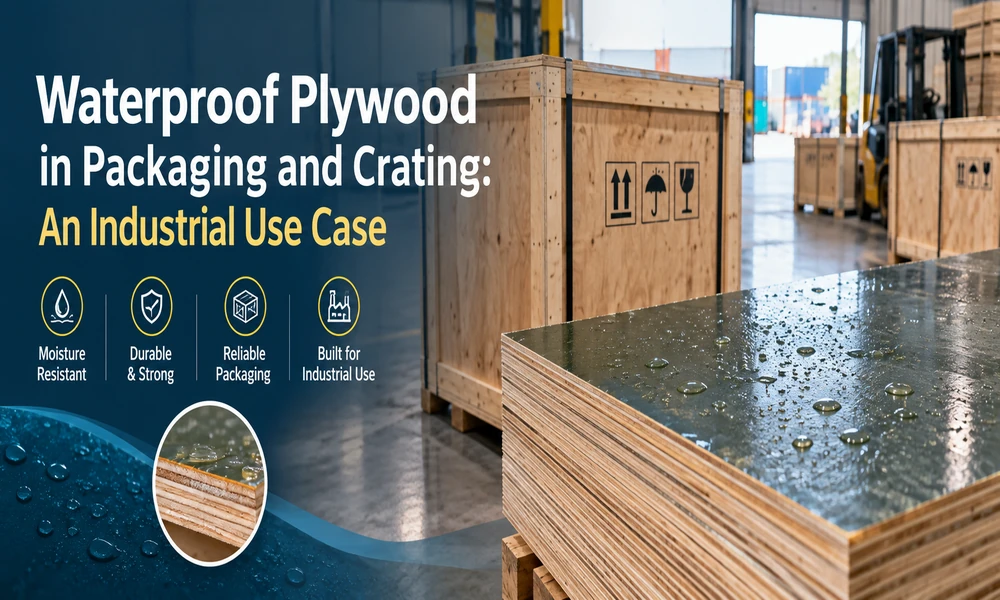
Industrial packaging does more than just keep a product covered. It also protects big machines, equipment, and valuable parts that need to be moved through changing weather conditions, manipulated repeatedly, and stored before their ultimate destination. This means the materials in crates and protective boxes balance strength, lightweight and moisture resistance.
High quality Waterproof plywood can be beneficial for this purpose as plywood is already a strong multilayered material, while waterproof grades provide a higher degree of resistance to moisture. The specific plywood grade chosen will depend on the type of goods being packaged, its method of transport, and how it will be affected by the environment.
Why Plywood Is Selected for Industrial Packing
Plywood is produced by binding layers of wood veneer together to make a board that is stronger and more stable than many solid wood boards. According to the information received, softwood plywood is relevant for packaging goods in addition to building and construction purposes.
In the context of industrial crates, together with strength, both structural and physical aspects of plywood can ensure that the goods, equipment, items, etc. are securely placed in boxes or crates, as plywood is a manageable and practical material to use.
How Waterproof Plywood Is Beneficial
Packaging is typically subject to rain and moisture, among other factors, during transport. Therefore, standard plywood used in dry conditions may not be adequate if the item is going to be exposed to moisture for a long time.
Boiling waterproof plywood, also known as BWP plywood, has a waterproof bonding, which has been designed in such a way that it provides a high level of resistance to moisture. The supplied material mentions that one of the advantages that comes with waterproof plywood is the fact that phenolic resin bonding has been used in its production, and as such, it can also ensure that the plywood can resist moisture ingress as well as long-term humidity exposure. As a result, if the packaging needs great protection against moist conditions, it pays to use waterproof plywood.
Strength and Weight Must Be Balanced
When building a crate, it is essential that its strength is enough to protect the contents without the addition of unnecessary weight. Selecting a plywood board just based on its thickness or weight can increase handling and transporting needs, without necessarily producing good results.
The thickness of the plywood board must be based on criteria such as the dimensions, weight and handling requirements of the item to be packed. Factors such as the design of the support framework and the connection and spacing of the support substructure also determine the overall efficiency of the manufacturer. As a result, while the construction of the plywood crate may be deemed waterproof, it is the design of the packaging which will dictate how well the board offers protection.
Waterproof Plywood for Export Applications and Long-Distance Transportation
The issue of moisture resistance becomes especially important when goods are shipped for considerable distances or when goods can be exposed to very different storage conditions. Often, a shipment has to go through a series of conditions that include high humidity, rain or condensation. However, utilisation of waterproof plywood will minimise this deterioration in the panel.
In the case of export applications, it is sensible to check specifications and treatment or certification requirements. While the supplied material mentions packaging as a mature application of the plywood space, it does not mention a universal standard for waterproof plywood, which is applicable for industrial export crates.
How to Choose Plywood for Industrial Crating
Select appropriate plywood based on the requirements of the product. Sometimes it is hard to imagine crates that need to be created to suit the dimensions, whatever the product being packed. Understanding factors such as the weight, dimensions, fragility, mode of handling, expected times in storage, and moisture exposure is vital.
When packing shipments, the plywood design should be chosen subsequently.
Because Boiling Waterproof plywood is designed to retain moisture in comparison with grades designed for dry conditions, it is a very useful material for the aforementioned application. Products can be selected from suppliers such as Royale Touche according to the specifications of construction, grade and moisture-resistant properties. Once the grade has been selected, it should be used with the proper support framework, connector and protective packaging materials.
Conclusion
Waterproof plywood has significant and useful applications in the world of industrial packaging and shipping in countries where high strength and resistance to moisture and reasonable weight are needed.